History · Volume 1
From Basement Rockets to the Estes Catalog
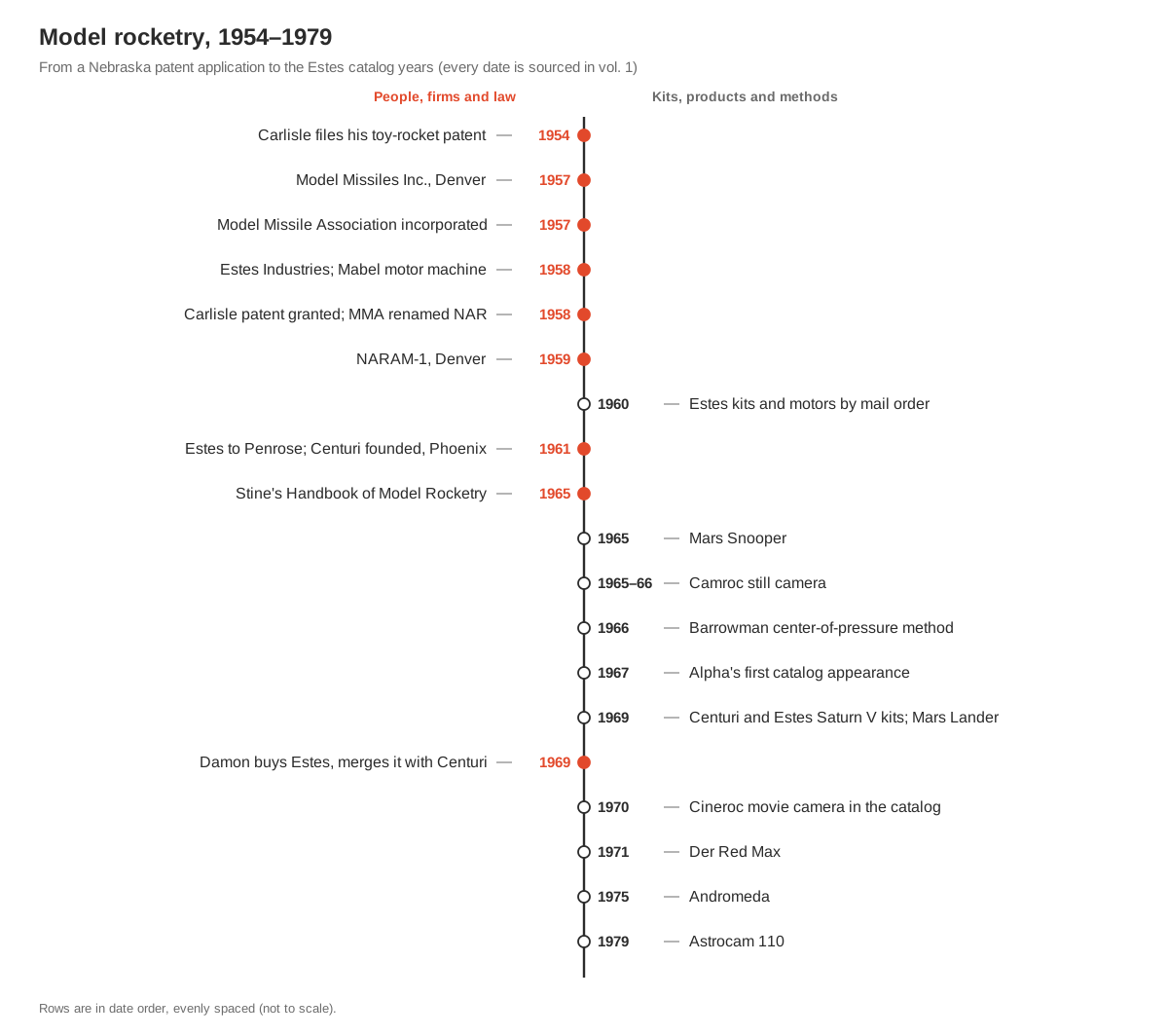
How a Nebraska shoe salesman's toy-rocket patent, a White Sands range engineer's safety campaign and a Denver fireworks family's motor machine turned the dangerous rocket craze of the 1950s into a mail-order hobby; and how the Estes and Centuri catalogs, the Apollo boom, contest flying, the Barrowman equations and the first rocket cameras shaped it through the 1970s
Introduction
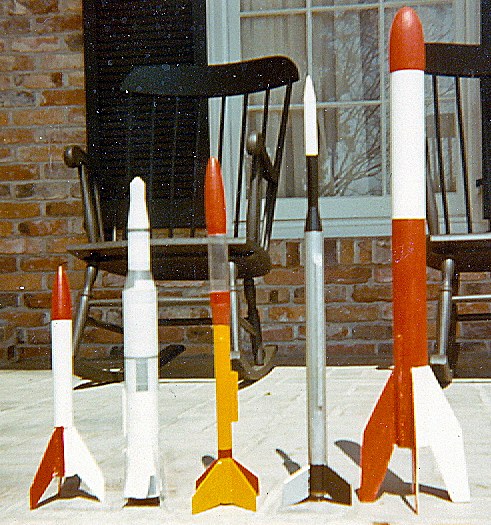
I have been building model rockets since I was about seven years old. Over the years I built nearly every rocket in the Estes catalog, and every birthday brought more kits. That makes the history in this volume personal in a particular way: the catalog was the hobby. A boy who wanted a rocket in the 1960s or 1970s did not usually find one in a shop. He found it on a page, cut out an order form, mailed a check to Penrose, Colorado, and waited. The kits on those pages, and the motors that flew them, were the end of a chain of events that began less than twenty years before with a toy-rocket patent filed in Nebraska.
This volume tells that story from the beginning: the amateur rocket craze of the 1950s and why it worried the professionals, the inventor who worked out what a safe model rocket had to be, the engineer who turned that into a movement, the fireworks maker’s son who built the machine that made the motors cheap, and the companies, catalogs, contests and cameras that followed. It ends at the close of the 1970s, when black-powder model rocketry had reached its mature form. The second volume picks up with high-power rocketry, composite motors and electronics.
Model-rocket history is full of confidently repeated stories that do not survive a check against the record, so this volume leans on primary sources: Orville Carlisle’s patent, the Museum of Flight’s holdings of G. Harry Stine’s papers, Vern Estes’s own oral history, the Smithsonian’s collection records, the court and regulatory record, and Tim Van Milligan’s Peak of Flight newsletter. Where sources disagree, the disagreement is stated rather than settled by guesswork.
1.1 Before model rockets: the amateur craze of the 1950s
After the Second World War, rockets were everywhere in the popular imagination. The V-2 had shown what a large liquid-fueled rocket could do, captured V-2s were flying from White Sands in New Mexico, and the Army, Navy and Air Force were building missile programs of their own. Rocket clubs and societies multiplied. William Colburn, writing in Peak of Flight in 2012, put their number at possibly over a thousand at the peak of interest in the mid-1950s, and recalled attending a 1957 launch at Camp A.P. Hill that the U.S. Army supported. Captain Bertrand Brinley’s Rocket Manual for Amateurs became the handbook of the movement; it is still a collector’s piece.
Most of those clubs did not build model rockets in the modern sense. They built rockets: metal tubes packed with propellants they mixed themselves. The favorites were zinc dust and sulfur (fast, simple and violent) and the “caramel candy” mixture of sugar and potassium nitrate. The Tripoli Rocketry Association’s own history, written about its founders’ teenage club in western Pennsylvania in the late 1960s, describes exactly this kind of work: metal airframes, zinc-sulfur and caramel-candy motors, and “the inevitable catastrophic failures” of some of them. That club was careful and lucky; Tripoli’s account notes that no one was ever hurt. Elsewhere, as Colburn puts it, “much experimentation took place, often unsupervised and foolishly conceived”, and the few disastrous experiments became notorious.
Colburn describes the professionals’ reaction. His father-in-law, Howard Seifert, then president of the American Rocket Society, wrote an article on the problem called “Ardent Youth”, a deliberate pun on ardent meaning both “enthusiastic” and “burning”. The professional community saw two things at once: young people experimenting dangerously and without supervision, and the next generation of rocket engineers, whom the country badly needed.
There were also toy rockets before the hobby proper. Colburn points to a model-rocket pamphlet that George James advertised in Popular Science in 1951, and to a U.S. patent (2,588,184, issued to W.R. Walsh) for a toy V-2 driven by a punctured carbon-dioxide cartridge, a type of rocket that appeared in Popular Science and Popular Mechanics through the late 1940s and 1950s. Neither was the hobby as it came to exist. What was missing was a way to fly a real solid-fuel rocket, again and again, without the flyer ever handling propellant.
1.2 Orville Carlisle and the Rock-A-Chute
Orville H. Carlisle (1917–1988) sold shoes in Norfolk, Nebraska. He was also, in Colburn’s phrase, a pyrotechnist, and his brother Robert, a model-aviation enthusiast, asked him to make a rocket that could be flown in demonstrations. Carlisle’s answer was the Rock-A-Chute.
On 30 August 1954 Carlisle filed a patent application for a “Toy rocket”. U.S. Patent 2,841,084 was granted on 1 July 1958. Read today, the patent is a description of the modern model rocket in one paragraph: a light tubular body that is reused; a separate, replaceable propulsion cartridge that does the work and is thrown away; and a timed second charge in the cartridge that, after the rocket has coasted, blows a folded parachute out of the body so that the rocket comes down slowly and can fly again. The flyer never touches propellant. He buys a finished motor, slides it in, and launches.
That division of labor (reusable airframe, factory-made single-use motor, built-in ejection charge) is the whole idea. Every black-powder model rocket since works the same way, and so does the basic layout of most high-power motors with motor ejection.
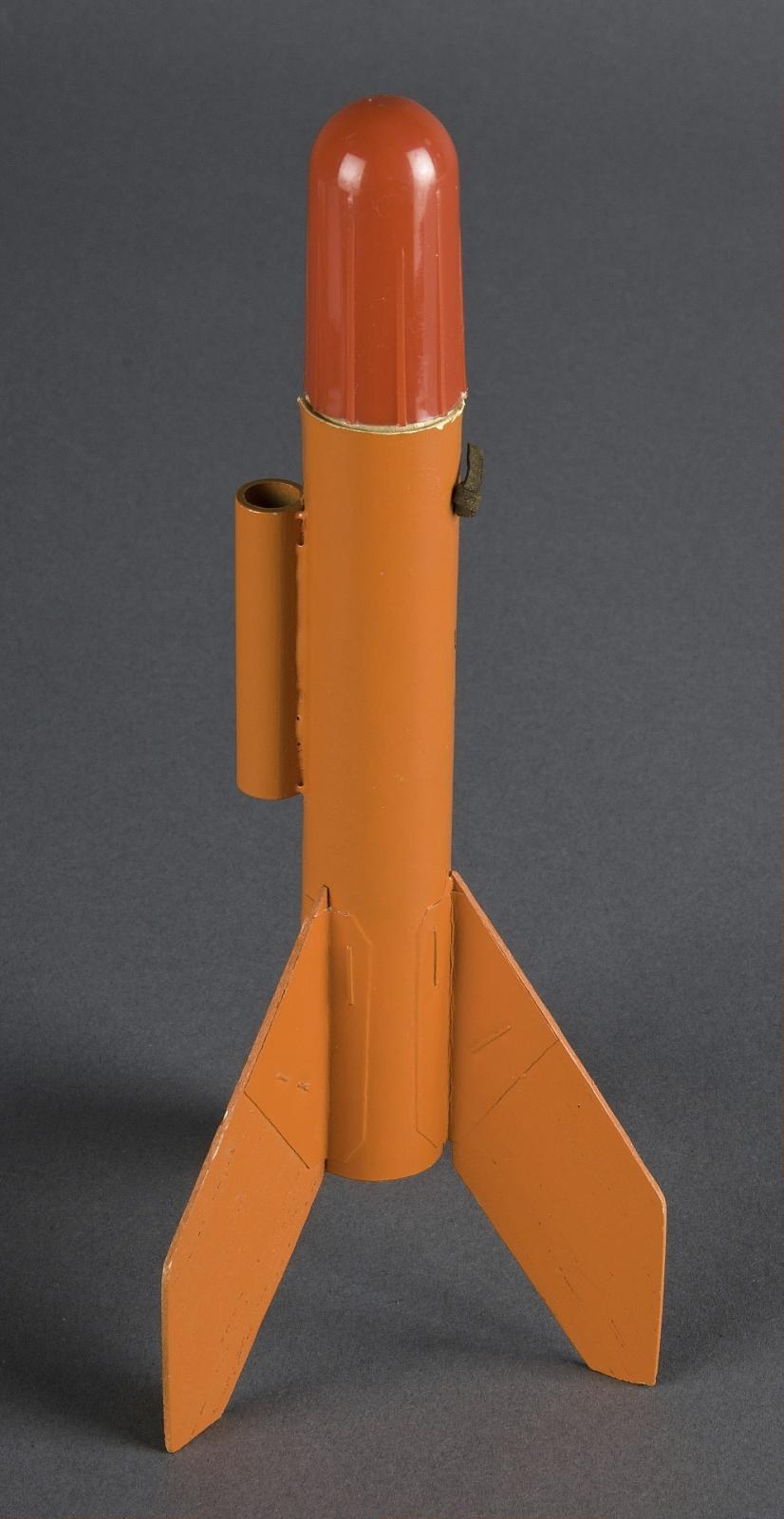
The Smithsonian’s National Air and Space Museum holds a Rock-A-Chute Mark II flying model (inventory A19930773000). Its record lists a kraft-paper body, balsa fins, a plastic nose cone and a plastic parachute, and gives the model’s length as 9¼ inches. It was a gift to the museum from G. Harry Stine. The museum also holds an unflown Carlisle Rock-A-Chute motor (A19930476000), a pasteboard tube with a non-explosive propellant.
Carlisle did not invent the idea of a small rocket, and he was not alone in thinking about safety. What he did was combine the pieces into a product that could be made, sold and flown by anyone, and then find the one person in the country best placed to turn it into a movement.
1.3 G. Harry Stine and Model Missiles Inc.
George Harry Stine (1928–1997) was born in Philadelphia and grew up in Colorado Springs. He took a physics degree at Colorado College in 1952 and went straight to White Sands Proving Ground in New Mexico, first as a civilian scientist and then, from 1955 to 1957, as head of the Range Operations Division at the U.S. Naval Ordnance Missile Test Facility there. He was also a prolific writer, of science fact under his own name and of science fiction as “Lee Correy”.
In 1957 Stine published a magazine article about the danger of amateur rocketry and the need for something safer. Which magazine it was is a small, persistent puzzle. The Wikipedia biography of Carlisle, citing Stine’s own later account in Sport Rocketry (January–February 1998), says it was the February 1957 Popular Mechanics. The Museum of Flight’s archival note and other sources say Mechanix Illustrated. Either way, Carlisle read it and wrote to Stine to tell him he already had the safe rocket Stine was asking for.
The Museum of Flight’s archival note puts it simply: the two “began a correspondence after the publication of an article in 1957.” Stine advised Carlisle on propellants and safe practice, and that same year the two founded Model Missiles, Incorporated in Denver, Colorado. The Museum of Flight describes it as the first manufacturer of model rockets and their motors. Its products included the Rock-A-Chute Mark II and a scale model of the Aerobee sounding rocket.
Then, on 4 October 1957, the Soviet Union launched Sputnik.
The timing could not have been better for a company selling safe rockets to teenagers. Ned Hood, writing in Peak of Flight #181 (2007), recalled the moment the hobby reached him. In the late summer of 1958 he and his friends heard “a jet-like sound” on a baseball field in Beverly, New Jersey, and watched a small white rocket climb almost out of sight and pop a red parachute. It belonged to a local doctor and his son. Hood, then thirteen and a follower of the space race, mailed off to Model Missiles in Colorado for his own; “it seemed like forever until the kit arrived”. With only A motors available, his Aerobee went to about 500 feet. Within a weekend he had drawn a two-motor booster, his father had rolled a booster tube out of red construction paper and white glue, and the two stages were being lit together with a Jetex fuse and a match. The first attempt left the upper stage behind on the pad; the second lit only one booster motor; the third worked.
Hood’s story shows the hobby as it was in its first year: mail order, A motors, home-made parts, a little danger, and the instant urge to go higher.
Model Missiles did not last. Ron Miller’s history for Gizmodo (2014) says it “folded after a short time”, and Wikipedia attributes its end to unwise business decisions. Its lasting legacies were the idea, the association that Stine built around it, and the man it hired to make its motors.
1.4 The National Association of Rocketry and the safety code
Stine’s other founding act of 1957 mattered more than the company. On 5 November 1957 (some sources give 7 November) the Model Missile Association was incorporated in Colorado, with Orville Carlisle, G. Harry Stine and Barbara K. Stine as its founding trustees. On 25 October 1958 an amendment to its articles changed the name to the National Association of Rocketry. Carlisle held membership number 1; Stine held number 2. Stine was its president until the late 1960s.
The NAR’s purpose was to make the hobby both safe and legal. William Colburn’s summary in Peak of Flight #314 (2012) is blunt: the NAR “became the legislative organization which finally made the hobby legal and restricted to commercially manufactured and safety tested motors.” That last clause is the heart of what became the Model Rocket Safety Code. Its principles have barely changed since the first years:
- fly only commercially made, tested motors, and never make, alter or reload them;
- build the rocket of light, breakable materials (paper, wood, plastic), with no metal airframe parts;
- launch electrically, from a distance, with a safety interlock and a countdown;
- launch from a rod or rail, close to vertical, away from people, power lines and buildings;
- bring the rocket back with a recovery device so that it can fly again.
Every point is aimed at the basement-rocket accidents of the 1950s. The flyer cannot be hurt mixing propellant because he never mixes propellant. He cannot be hit by a metal shell because there is no metal shell. He cannot be standing over the rocket when it lights because it is lit electrically from a distance. Carlisle himself wrote an early guide, “The Do’s and Don’ts of Model Rocketry”, for the first issue of The Model Rocketeer in February 1958.
The rules worked. Model rocketry became, and has remained, one of the safest of the hands-on technical hobbies, and the NAR code became the basis of the U.S. fire-code standard for model rocketry, NFPA 1122. The NAR’s own website still describes it as the oldest and largest spacemodeling organization in the world.
The code’s definition of a model rocket (light, breakable, commercial motor, recoverable) is the one used throughout this site. The Basic Rockets dive sets out its current limits; the History dive is concerned with where they came from.
1.5 Vern Estes and Mabel
Model Missiles’ problem was supply. Its motors were made by hand, and demand quickly outran production. By 1959, by Wikipedia’s account, the company was looking for an outside supplier. It found one in Denver, in a family fireworks business.
Vernon Estes was born on 4 January 1930. His family’s business was, in Wikipedia’s phrase, the first fireworks company listed in the Denver phone book, and Colburn’s article names it Mile High Fireworks. Vern agreed to make motors for Model Missiles and set out to mechanize the job.
The clearest account of what followed is Vern Estes’s own, from an oral history recorded for the Museum of Flight and excerpted on the museum’s blog in 2021. He describes the machine he built as “the first automated equipment to manufacture model rocket engines”. It took him several months. He designed its rotary table from what he had seen at a Denver bottling plant where he had worked in high school. It used hydraulics to press the powder and pneumatics to run the automation, which kept electric sparks away from the black powder, and many of its parts came from junkyards. Once running it turned out a motor “at the rate of about one every five and half seconds or so”, and it ran around the clock: “We ran 24/7.”
The machine got its name from an early employee who ran it and named it after a woman he knew, because it was “a bit stubborn sometimes”. It was Mabel. Asked when, Vern said “That was ‘58”, and he thought the first Mabel stayed in service until about 1965. Later machines followed (he thought seven were built in all), and an accident in Denver led to the operator being moved behind a concrete barrier on later generations. The original Mabel was thrown out as junk in the 1970s, while Damon owned the company.
Dates for Mabel vary. Vern dated it to 1958; a fan-compiled chronology dates the first MMI motor from “Mabel-1” to January 1959; a corporate history says only that the machine could make “ten engines a minute”. The rate and the year are close enough that the differences do not change the story. What matters is the consequence. Mabel made motors faster than Model Missiles could use them, and the motors were more consistent than hand-rammed ones. Vern was left holding a machine that could supply a far bigger hobby than existed.
1.6 Estes Industries and the mail-order catalog
Vern and his wife Gleda founded Estes Industries in Denver in 1958. When Model Missiles failed, Estes stopped being a supplier and became the hobby. In 1960 the company began selling rocket kits, as well as motors, by mail. The first kit was the Astron Scout, a rocket small enough to be shipped inside the cardboard tubes used to mail motors. Wikipedia gives its price as seventy cents.
In 1961 Estes moved out of Denver to a 77-acre site near Penrose, Colorado, on U.S. Highway 50, for safety reasons: a factory full of black powder does not belong in a city. Penrose has since been billed as the model-rocket capital of the world. For three generations of American children, a Penrose address on an order form was where rockets came from.
Estes’s business was built on mail order and the catalog. The catalog was a sales tool, but it was also a textbook: kits arranged by skill level, a motor chart, explanations of how and why rockets fly, and pages of products that a reader could not yet afford and therefore studied all the harder. Estes also published technical reports and a newsletter, Model Rocket News. Tim Van Milligan, who later ran Apogee Components, wrote in Peak of Flight #500 (2019) that he deliberately patterned Apogee’s marketing on what Estes did in the late 1950s and 1960s, including selling technical reports through the catalog. By the end of the 1960s Estes offered more than fifty kits.
The kits themselves settled into a family that is still recognizable. Paper body tubes in standard sizes, balsa fins, a balsa or plastic nose cone, a plastic parachute or a crepe-paper streamer, a launch lug and a motor hook. The Alpha, the archetypal sport rocket of the period and still in production, is generally credited to Estes designer Bill Simon; its first catalog appearance was in 1967, though collectors have found it advertised in Model Rocket News as early as December 1965. The black-powder motors themselves, coded by letter for impulse class, are covered in the Motors dive.
I built nearly every rocket in that catalog, one or two at a time, and every year my birthday brought more.
1.7 Centuri and the competition
Estes was never quite alone. In 1961, the year Estes moved to Penrose, Lee Piester started Centuri Engineering in his garage in Phoenix, Arizona. Through the 1960s Centuri was the other big name in American model rocketry, with its own catalog, its own kits and its own motors, and a reputation for ambitious scale models. Cox, already established in model aircraft, also sold rockets for a time.
The Apollo years changed the industry’s ownership. In 1969 Vern Estes sold his company to the Damon Corporation of Needham, Massachusetts, and Damon merged Estes with Centuri. (A corporate history in the International Directory of Company Histories gives 1969 in its narrative and 1970 in its chronology; Wikipedia’s articles on Vern Estes and Estes Industries both give 1969.) Vern remained a familiar figure at launches for decades after; when the NAR gave Cineroc designer Mike Dorffler a lifetime-achievement award, it was Vern Estes who presented it.
Under Damon the two brands ran side by side for more than a decade. By the early 1980s Centuri’s marketing and product development had been absorbed into Estes, and the Centuri product line was discontinued in 1983. Lee Piester and other former Centuri people went on to found Enertek and, later, Quest Aerospace, both of which reappear in the next volume.
The catalog companies did not have the field entirely to themselves. Throughout the period there were small makers of kits, parts and motors, many of them run by active flyers and contest modelers; the Peak of Flight archive is full of their stories. But for most young builders the hobby meant Estes, and sometimes Centuri.
1.8 The Apollo boom and the scale kits
Model rocketry grew up alongside the American space program, and the program supplied its most popular subjects. The great boom came with Apollo.
Both major companies brought out Saturn V kits in 1969. According to collectors’ records, Centuri’s came first, early in the year, and Estes’s followed later in 1969. Both were nominally 1:100 scale. The Estes kit (catalog number K-36, later 1236) stayed in production until 1985, and Estes also sold a simpler semi-scale Saturn V from 1969 to 1979. A corporate history notes that a multi-stage Saturn V kit became a best seller, and that interest in model rockets declined once the Moon had been reached. Estes reissued the Saturn V for the fiftieth anniversary of Apollo 11 under the model number 1969.
The Saturn V is one of my favorites to this day.
The most theatrical Saturn V flight of the era was indoors. On 31 December 1969, at halftime of the Bluebonnet Bowl in the Houston Astrodome, Estes staged a launch of a Saturn V model inside the stadium; the event was reported in Model Rocket News in February 1970.
The space program also shaped the hobby’s fantasy kits: the rockets of an imagined future of Mars landings and interplanetary probes. Three of my own favorites come from that strand of the catalog:
Table 1 — The space program also shaped the hobby's fantasy kits: the rockets of an imagined future of Mars landings and interplanetary probes. Three of my own favorites come from that strand of the catalog
| Kit | Maker and number | In production | Notes |
|---|---|---|---|
| Mars Snooper | Estes K-20 | 1965–1974 | First catalog appearance in 1966. Followed by the Mars Snooper II (1975–1980) and later the Super Mars Snooper. |
| Saturn V | Estes K-36 / 1236 | 1969–1985 | 1:100 scale; Centuri’s Saturn V appeared earlier the same year. |
| Mars Lander | Estes K-43 / 1243 | 1969–1983 | A lander-shaped design, now a collector’s favorite and the subject of upscales and clones by other makers. |
| Der Red Max | Estes KC-2 | 1971–1986 | A Citation Series kit; reissued by Estes in 2007. |
| Andromeda | Estes 1273 | 1975–1982 | A futuristic design; a Mattel-distributed version was sold in Germany in 1978–79. |
Production years are as compiled by the Rocket Reviews kit database and collectors’ catalog studies; Estes has not published an official production history. They are good to a year, not to a month.
I have built the Mars Snooper from the Estes kit, and again as a much larger high-power rocket. The Mars Lander, the Andromeda and the Saturn V are among my favorites too, and so is the Mega Der Red Max, the large modern version of the Der Red Max, which belongs to the next volume’s story.
1.9 Contests and NARAM
From the start the NAR organized competition, and competition drove much of the hobby’s technical progress. The first National Association of Rocketry Annual Meet (NARAM-1) was held in Denver in 1959, hosted by the Mile-Hi section, the NAR’s section number 1. The Museum of Flight holds Stine’s own black-and-white photographs of that first meet, among the earliest images of organized model rocketry.
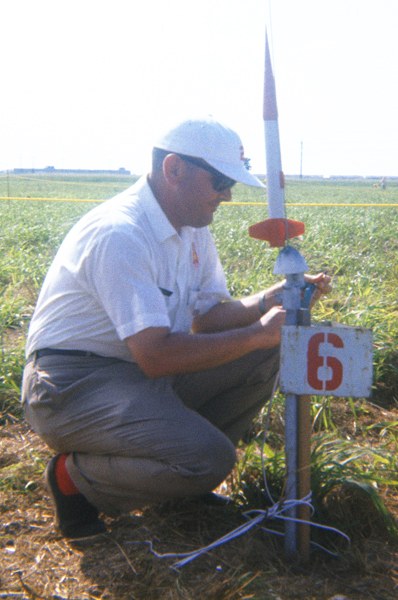
NARAMs moved around the country in the following years; by NARAM-12 in 1970 the meet was in Houston, where G. Harry Stine was photographed preparing a rocket at the pads. Contest events tested altitude, duration under parachute and streamer, boost gliders, payload lifting (raw eggs, eventually), craftsmanship in scale models and, in the research and development category, original technical work.
Stine also carried model rocketry into international competition through the Fédération Aéronautique Internationale (FAI), which governs air sports worldwide. In 1985 the FAI awarded him its Paul Tissandier Diploma.
1.10 Barrowman and the center of pressure
The most important single product of the contest system was not a rocket but a method.
A rocket is stable if its center of gravity (CG) is ahead of its center of pressure (CP): the point at which the aerodynamic side forces on the rocket effectively act. The CG is easy to find by balancing the rocket. The CP is not. Tim Van Milligan, in Peak of Flight #238 (2009), describes the three ways a modeler of the early 1960s could check stability before flying:
- A wind tunnel, the accurate method, available to almost no one.
- The cardboard cut-out, in which a silhouette of the rocket is cut from card and balanced on a knife edge to find its center of lateral area. It treats the rocket as if it were flying sideways, and it puts the CP well forward of where it really is, so a rocket that passes is over-stable and usually too nose-heavy.
- The swing test, in which the rocket is hung on a string at its CG and whirled around the head to see whether it flies point-first.
All three were guesses. Then, at NARAM-8 on 18 August 1966, James S. Barrowman and Judith A. Barrowman presented a research and development report, The Theoretical Prediction of the Center of Pressure. Its stated objective was “to derive subsonic theoretical center of pressure equations of a general rocket configuration”. James Barrowman was an aerospace engineer at NASA. The report’s equations break a rocket into nose, body, transitions and fins, give each part a normal-force coefficient and a center of pressure from simple geometry, and combine them into a CP for the whole rocket.
The Barrowman equations gave every modeler with a pencil and a ruler a usable CP. They became the standard in kit design and contest work, and later the basis of the stability calculations in computer design programs, including the RockSim and OpenRocket software of the next volume. Van Milligan’s 2018 article in Peak of Flight #470, “What Barrowman Left Out”, is a reminder that the method has limits (it ignores the body tube’s lift at angle of attack, for instance), but its importance to the hobby is hard to overstate. The original typed report, with hand-drawn diagrams and handwritten addenda, is in the Museum of Flight’s archives.
The physics of the CG and CP, and why the CG must lead, is set out in the Basic Rockets dive; designing with these methods is the subject of the RockSim dive.
1.11 Cameras in the nose cone
The early rockets went up, came down and could only be judged from the ground. The next step was to send a camera up with them.
1.11.1 Camroc
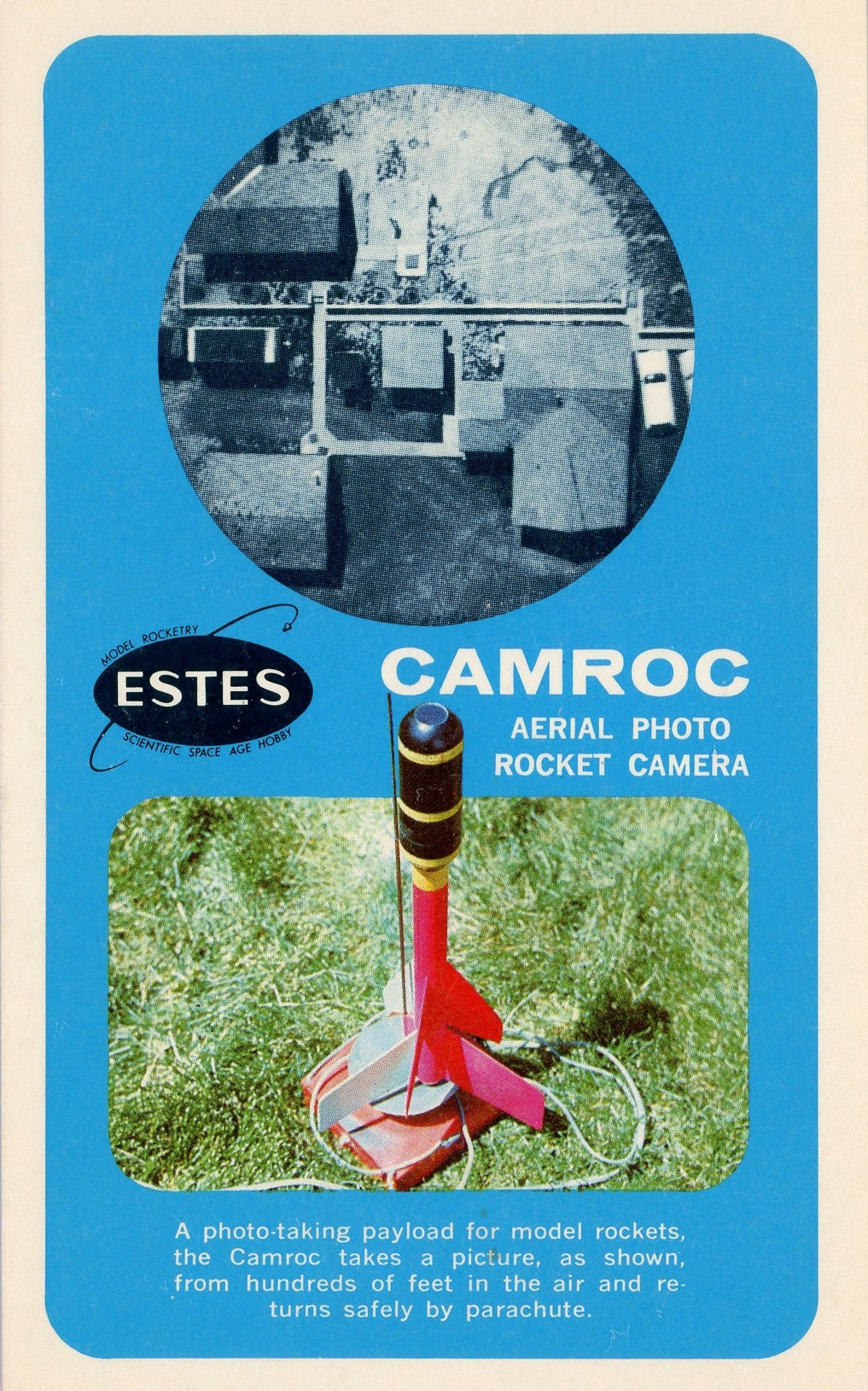
Estes’s Camroc was the first commercially produced camera designed to be carried aloft by a model rocket. Sources date it to the mid-1960s: some give 1965, others 1966. It took a single still photograph per flight. The camera had essentially one moving part, a rubber-band-powered shutter that was tripped when the motor’s ejection charge fired to release the parachute, so the picture was taken looking down from near apogee. The film was a small disk of black-and-white film about 1½ inches across, which the flyer cut and loaded in a darkroom, then developed at home or sent to Estes for processing. Estes’s own promotional postcard promised that the Camroc “takes a picture, as shown, from hundreds of feet in the air and returns safely by parachute”.
1.11.2 Cineroc
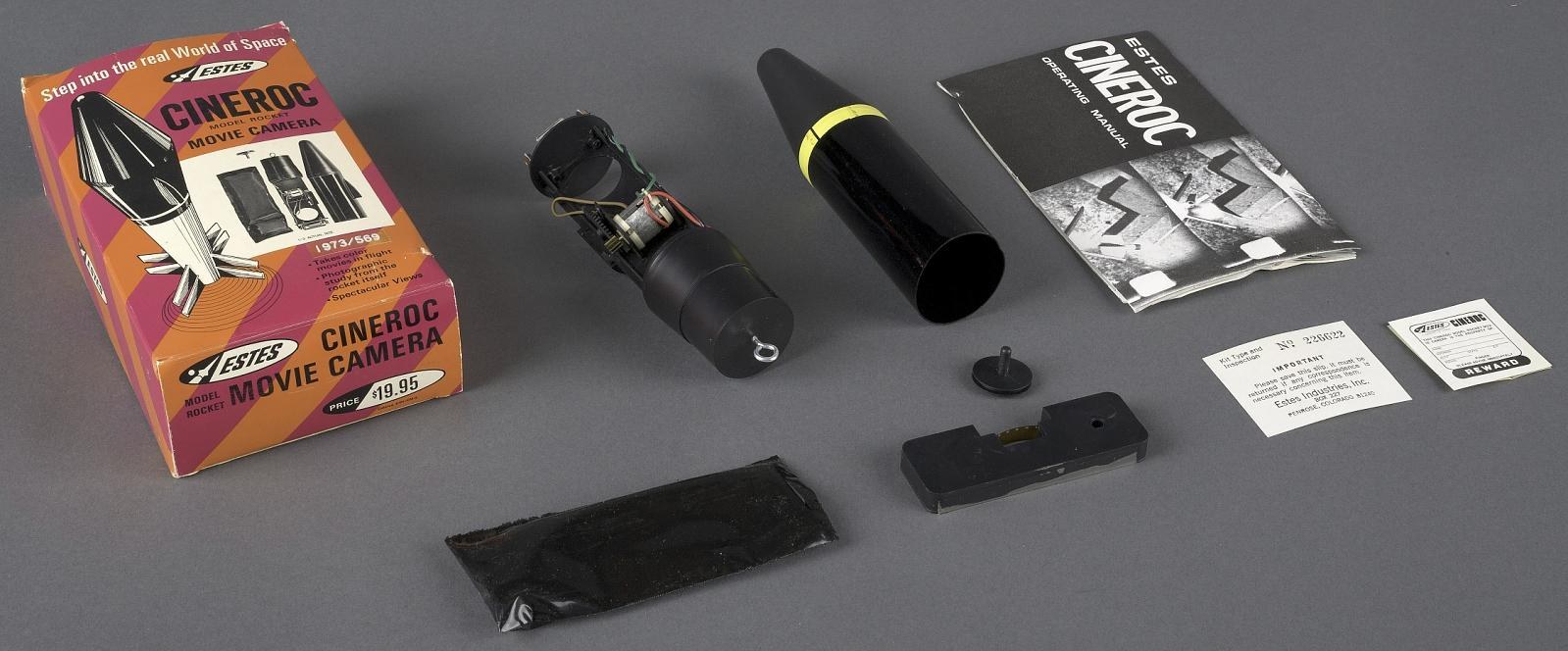
The Cineroc went further: a movie camera in a nose cone. Designed by Estes’s Mike Dorffler, who also designed the Camroc, it carried a short length of 8 mm movie film driven by a small electric motor, and filmed the flight from the nose looking down. Accounts describe about twenty seconds of film at roughly thirty frames per second; it was typically flown on Estes’s Omega, a two-stage rocket designed to carry it. The 1970 Estes catalog listed it at $19.95, a fortune for a child that year. Collectors’ records give its production run as 1970 to 1975.
The National Air and Space Museum holds a boxed Cineroc, given by Estes Industries itself (inventory A19730569000): the camera body with its motor and film gate, the black nose cone, film, and the operating manual and warranty card.
Both cameras disappeared from the catalog in the mid-1970s. Their successor arrived in 1979: the Astrocam 110, which took standard 110 cartridge film, so that the pictures could be developed at any drugstore. The Astrocam was later updated in 1993. The rocket camera, in other words, followed the consumer camera industry, and it kept on following it into the electronic era described in the next volume.
I flew several film cameras in my early rockets, before graduating to electronic video.
1.12 Stine’s handbook and the literature of the hobby
The hobby was always a reading hobby as well as a building one. G. Harry Stine’s Handbook of Model Rocketry appeared in 1965 and went through seven editions; for decades it was the book a serious young modeler owned. Estes’s catalogs, technical reports and newsletter, Centuri’s catalogs, the NAR’s successive magazines (The Model Rocketeer, and later American Spacemodeling and Sport Rocketry), and contest R&D reports such as Barrowman’s together made up a technical literature that taught a generation the basics of aerodynamics, propulsion and recovery.
That literature is also where most of this history survives. Stine wrote a history of Carlisle (NAR number 1) for the September 1988 American Spacemodeling, and Tom Beach wrote a three-part account of Vern Estes’s early years for Sport Rocketry in 2007; both are cited by Colburn in Peak of Flight #314. The Museum of Flight in Seattle now holds Stine’s papers and photographs as the G. Harry Stine Space History and Model Rocketry Collection, much of it digitized.
1.13 By the end of the 1970s
By the end of the decade, model rocketry had reached the form it would keep for the next forty years at the low-power end:
- Motors were black-powder, single-use, made by machine in Penrose and coded by impulse class, average thrust and delay.
- Kits were paper, balsa and plastic, sold by mail and increasingly in hobby shops, from beginners’ rockets to multi-stage scale models of the Saturn V.
- Safety rested on the NAR code: commercial motors, electrical launch, light materials and recovery.
- Design rested on the Barrowman equations.
- Payloads had grown from raw eggs to still and movie cameras.
- The industry was dominated by a single company owned by a conglomerate, with Centuri soon to disappear.
What it did not yet have was power. The biggest commercial black-powder motors were small, and black powder does not scale well into larger motors. Builders who wanted bigger, heavier and faster rockets had to look elsewhere: to composite propellant, to the amateur traditions that the NAR had set itself against, and to a new kind of launch in a field in Ohio. That is where the next volume begins.
Sources
- Carlisle, Orville H., Toy rocket, U.S. Patent 2,841,084, filed 30 August 1954, granted 1 July 1958 — https://patents.google.com/patent/US2841084A/en.
- Smithsonian National Air and Space Museum, Rocket, Flying Model, Carlise Mark II Rock-a-Chute, A19930773000 (gift of G. Harry Stine) — https://airandspace.si.edu/collection-objects/rocket-flying-model-carlise-mark-ii-rock-chute/nasm_A19930773000; and Motor, Model Rocket, Orville Carlisle Rock-a-Chute Type, A19930476000.
- Smithsonian National Air and Space Museum, Rocket, Flying Model, Movie Camera, Cineroc, A19730569000 (gift of Estes Industries) — https://airandspace.si.edu/collection-objects/rocket-flying-model-movie-camera-cineroc/nasm_A19730569000.
- The Museum of Flight Archives, G. Harry Stine Space History and Model Rocketry Collection (biographical note on Stine) — https://archives.museumofflight.org/repositories/2/resources/268; Model Missiles, Inc. (historical note) — https://archives.museumofflight.org/agents/corporate_entities/1341.
- The Museum of Flight Archives, James S. and Judith A. Barrowman Report, “The Theoretical Prediction of the Center of Pressure”, NARAM-8, 18 August 1966 — https://archives.museumofflight.org/repositories/2/resources/579.
- Mobley, Sean, “How to Build a Rocket Engine”, The Museum of Flight blog, 21 September 2021 (excerpts from Vern Estes’s oral history) — https://blog.museumofflight.org/flightdeck/how-to-build-a-rocket-engine.
- William Colburn, “Where Did Model Rocketry Really Start?”, in Tim Van Milligan (ed.), Peak of Flight #314 (2012). (Library copy)
- Ned Hood, “A Personal View on Model Rocketry History”, in Peak of Flight #181 (2007). (Library copy)
- Tim Van Milligan, “What is the Difference Between the RockSim Method and the Barrowman Equations”, Peak of Flight #238 (2009); “What Barrowman Left Out”, Peak of Flight #470 (2018); “A Retrospective History of the Peak-of-Flight Newsletter”, Peak of Flight #500 (2019). (Library copy) (Library copy) (Library copy)
- Tripoli Rocketry Association, Tripoli History (on 1960s amateur practice) — https://www.tripoli.org/History.
- Miller, Ron, “The Dangerous Origins of Model Rocketry”, Gizmodo, 18 March 2014 — https://gizmodo.com/the-dangerous-origins-of-model-rocketry-1527675855.
- “Centuri Corporation”, International Directory of Company Histories (via Reference for Business) — https://www.referenceforbusiness.com/history2/9/Centuri-Corporation.html.
- Wikipedia, Orville Carlisle, Vernon Estes, Estes Industries and NARAM (dates cross-checked against the sources above; used alone only where noted in the text).
- Rocket Reviews kit database (production years for the Mars Snooper, Mars Lander, Andromeda, Der Red Max and Saturn V kits) — https://www.rocketreviews.com/.
- Branwyn, Gareth, “Remembering Mike Dorffler, Cineroc Creator”, Make:, 17 October 2011 — https://makezine.com/article/home/fun-games/remembering-mike-dorffler-cineroc-creator/.
- Williams, Al, “The King of Rocket Photography”, Hackaday, 16 November 2025 (Camroc and Astrocam 110 dates) — https://hackaday.com/2025/11/16/the-king-of-rocket-photography.
- rcgrabbag, “Estes Camroc (1966)” (shutter and film details) — https://www.rcgrabbag.com/estes-camroc-1966.