Motors · Volume 1
Model-Rocket Motors
Black powder and single-use composite motors from the inside out: how the grain, nozzle, delay and ejection charge work, why a black-powder motor spikes and a composite one does not, what a CATO is, how motors are certified, how to read a code and a thrust curve, and how to choose, buy, store and dispose of the right motor for a rocket
Introduction
I have been building model rockets since I was about seven, nearly every kit in the Estes catalog among them, and I have flown high power for many years as a member of both the NAR and Tripoli. The motor is the one part of a model rocket the flyer does not make. It arrives sealed and certified, and the flyer’s whole job is to pick the right one and fit it properly. That job is easy to do badly. A motor that is too weak for the rocket arcs it over into the crowd. A delay that is too long brings the parachute out on the way down. A motor stored in a hot car for a summer can fail on the pad.
This volume covers the motors a flyer can buy without certification: black-powder motors from 1/4A to F, and single-use composite motors up to G. It explains how each kind works inside and why their thrust curves look so different. It covers how a motor is certified, how to read its code and thrust curve, how to choose one for a given rocket, and how to buy, store, transport and dispose of motors. The second volume covers high-power reloadable motors, propellant grain design, certification levels and research motors.
Basic Rockets, volume 1, already introduced the motor code, the impulse classes and the layers of a black-powder motor. This volume assumes that and goes deeper.
1.1 What a rocket motor has to do
Every solid-propellant hobby motor does the same four jobs in sequence:
- Make thrust. Burning propellant fills the motor with hot gas at high pressure. The gas can leave only through the nozzle, and the reaction to that jet pushes the rocket.
- Wait. After the propellant is gone, a slow-burning delay burns for a set number of seconds while the rocket coasts upward. It makes a smoke trail but no useful thrust.
- Eject. When the delay burns through, it lights a small ejection charge that fires forward into the rocket and pushes the recovery system out.
- Hold together. Throughout, the case, nozzle and bulkheads have to contain the pressure, and the motor has to stay in the rocket.
The two families of hobby motor do these jobs with very different materials. A black-powder motor is a paper tube packed with pressed powder and clay. A composite motor has a rubbery propellant cast into a plastic, phenolic or aluminum case. The differences in how those two propellants burn explain almost everything else in this volume: why black-powder motors are end-burners and composites are cored, why black powder spikes at ignition, why there are no composite booster motors, and why a composite motor of the same size delivers roughly two and a half times the impulse.
1.2 Black powder: the propellant
Black powder is the oldest propellant there is. The standard modern mixture, settled by about 1780, is by weight 75 % potassium nitrate, 15 % charcoal and 10 % sulfur. The potassium nitrate supplies the oxygen, the charcoal is the main fuel, and the sulfur lowers the ignition temperature and speeds the burn.
Black powder is a low explosive. It deflagrates: it burns very fast, but the reaction front travels more slowly than sound, so it does not detonate. Because it carries its own oxidizer, it burns faster when it is under pressure. Loose granular powder burns far faster than a pressed solid, because the flame jumps from grain to grain through the gaps. Pressed hard into a dense, solid slug, the same powder burns steadily from its exposed surface. A rocket motor relies on that.
The disadvantage of black powder is its low energy. Specific impulse, the impulse a propellant delivers per unit weight, is the standard measure of propellant efficiency, in seconds. The certification data for an Estes C6 give 8.82 N·s from 10.8 g of propellant. That works out to about 83 seconds. A composite motor of similar size does better than 200 seconds (see Composite motors). That gap is why black powder stops at about the E and F classes: beyond that, the motor would be impractically long and heavy for the impulse it delivers.
1.3 Inside a black-powder motor
A black-powder model rocket motor is made by pressing its layers, one after another, into a heavy spiral-wound paper tube. From the nozzle end forward (Figure 1):
- The nozzle is a plug of pressed clay with a hole through it. The hole narrows to a throat and then widens. Hot gas accelerates through the throat and leaves faster than it would through a plain hole.
- The propellant grain is pressed black powder, filling most of the tube. In most Estes motors it is a cored end-burner: it burns from the nozzle end forward like a cigarette, but it has a short conical cavity at the nozzle end. That cavity gives the igniter more surface to light and gives the motor a burst of extra thrust at the start.
- The delay grain is a slower-burning composition pressed in front of the propellant. It makes smoke but no useful thrust.
- The ejection charge is a small loose charge of black powder in front of the delay, held in by a thin clay cap or paper disc.
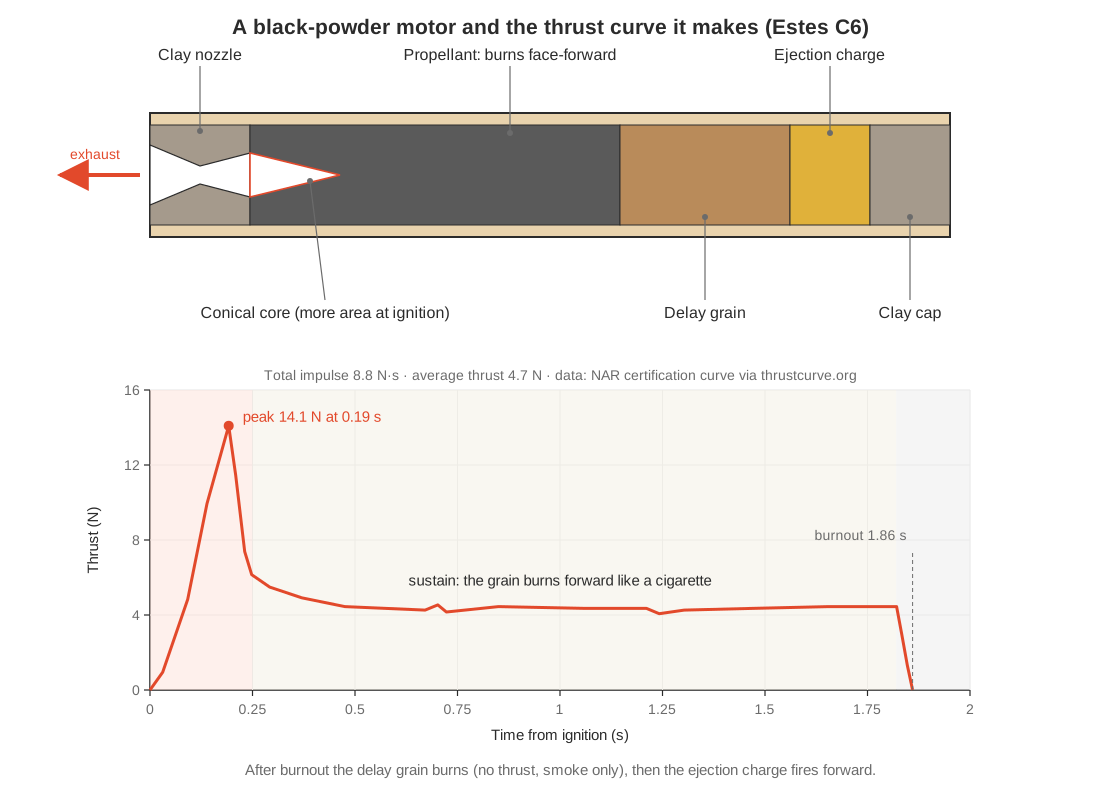
Only the propellant makes useful thrust. The rest of the motor is a timer and a gas generator for the recovery system.
1.3.1 Why a black-powder motor spikes
The thrust a solid motor makes depends on how fast it turns propellant into gas, and that depends on how much propellant surface is burning. An end-burning grain burns only on its flat face, so the burning area stays nearly constant and the thrust is nearly flat. The conical core adds a short burst of extra area at the start.
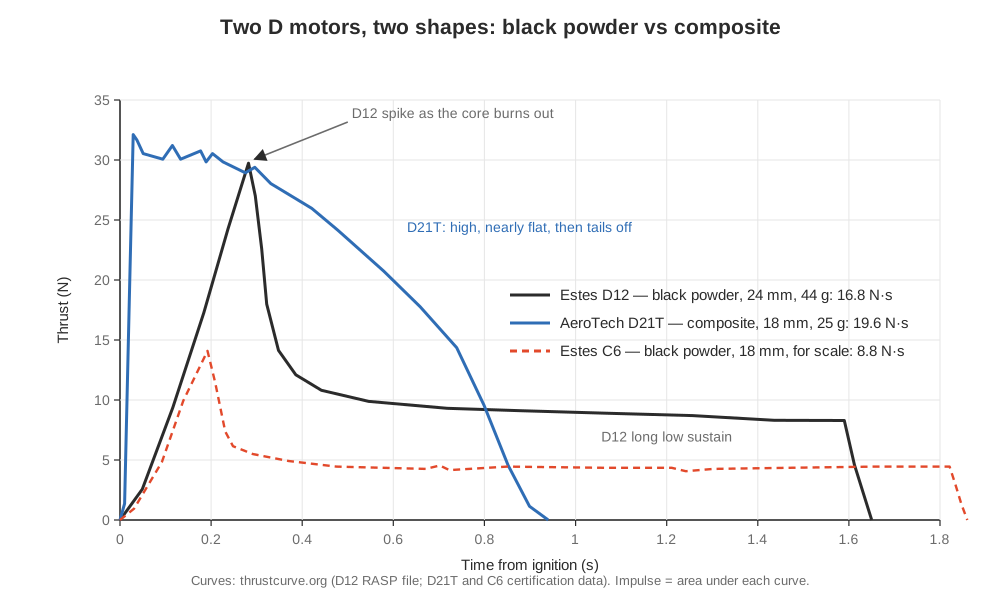
The result is the curve in Figure 1. When the igniter lights the cone, the whole inner surface of the cone burns at once. The burning area is much larger than the flat face, so the thrust climbs steeply to a peak: 14.1 N at 0.19 seconds in the Estes C6 certification data. Within a fraction of a second the cone burns out and the burning surface flattens into a plain disc. The thrust drops to a long, low sustain of about 4–5 N, which lasts until burnout at 1.86 seconds.
That shape is deliberate. The spike is the rocket’s kick off the launch rod. A model rocket has no steering, and its fins only work once air is flowing over them fast enough. The spike accelerates the rocket hard during the first meter of travel, so it leaves the rod fast enough to fly straight. The long sustain after it is efficient. A rocket that is already moving loses less of the motor’s energy to drag and gravity if the push continues gently than if it all comes at once.
Other Estes black-powder motors share this shape. The Estes D12 peaks at about 29.7 N, about 0.28 seconds after ignition, and then sustains at 8–10 N for over a second (Figure 4, below). Ken Kosanke’s glossary of grain geometries gives the same reason for the core: it eases ignition and gives a higher initial thrust, which raises liftoff speed and stabilizes the rocket sooner (Peak of Flight #341).
1.3.2 Delay and ejection
When the propellant burns through, the flame reaches the delay grain. The delay is formulated to burn slowly and steadily and to make a thick smoke trail, which is how spectators follow a rocket through its coast. Its length sets the delay time printed on the motor: the “5” in C6-5. When the delay burns through, it lights the ejection charge. The flash blows out the clay cap and fires a burst of hot gas forward, which pushes out the wadding, parachute and nose cone.
Delay times are not exact. NFPA 1125, the fire-code standard to which motors are tested, allows the measured delay to differ from the printed value by 20 % or 1.5 seconds, whichever is greater, but never by more than 3 seconds. A motor labelled with a 4-second delay therefore complies if its delay is anywhere from 2.5 to 5.5 seconds (Curtis Lee, Peak of Flight #595). That tolerance is one reason to pick the delay from a simulation and then choose the nearest available delay on the short side.
1.3.3 Booster motors: delay zero
A -0 motor (A10-0, B6-0, C6-0, D12-0) is a booster. It has no delay and no ejection charge in the usual sense. Tim Van Milligan explains how it works: at the end of the burn, the last of the propellant breaks through at the front of the motor and acts as the ejection charge. The hot gas and burning particles fly forward into the nozzle of the upper-stage motor and light it (Peak of Flight #49). This is direct staging, and it needs no electronics. It works only because the pressed black-powder grain is hard enough to act as a bulkhead right up to the end of the burn. As the composite section explains, a composite grain cannot do that.
1.3.4 Plugged motors
A P in place of a delay number (D12-P in some product lines, A10-PT, and composite “-P” reloads) means plugged. The forward end is sealed, and the motor has no delay or ejection charge. Plugged motors are used in rocket gliders, in rockets whose recovery is deployed by an altimeter or timer, and in some upper stages.
1.4 When a motor fails: the CATO
CATO is hobby slang for a catastrophic failure of a motor. Exactly what happened varies, but in every case the pressure inside the motor did something other than leave through the nozzle. A CATO can blow the nozzle out the back, blow the forward end and the ejection charge into the rocket, split the casing, or burn through the side. It often destroys the rocket’s motor mount and tail. On the pad, it can scatter burning debris.
1.4.1 The physics
A solid motor runs in a balance. Gas is made at a rate set by the burning area and by how fast the propellant burns. Gas leaves at a rate set by the size of the nozzle throat and the pressure in the chamber. Black powder, like any propellant, burns faster when the pressure rises. If the burning area suddenly increases, more gas is made, the pressure rises, the propellant burns faster still, and the pressure climbs until either the nozzle can pass the extra gas or something gives way.
One way that happens in a pressed black-powder motor is a crack or separation in the grain. A crack running into the grain exposes new burning surface. A gap between the grain and the paper case lets flame run down the outside of the grain, so the whole length burns at once. Either way, a motor designed to burn only on its end face suddenly has many times the burning area. Black powder is strong but brittle, and the grain, clay and paper expand and shrink by different amounts with heat and cold. Repeated swings between hot and cold can open those gaps.
Estes’s guidance on old motors says the same thing in practical terms. Motors have no fixed shelf life if they have always been kept cool and dry. The damage comes from humidity and temperature cycling, for example motors left in a car trunk through a winter and a summer. The visible warning signs include an eroded clay cap with dark propellant showing on its sides, a bulging casing, a casing that is starting to unwrap, or a crumbling nozzle or cap. A motor with any of those signs should not be flown (see Disposal).
Other causes are more mundane: a nozzle blocked by debris or by an igniter plug pushed in too far, a motor damaged in handling, or a manufacturing defect.
1.4.2 Living with CATOs
Certified motors rarely fail, but they do fail. That is the reason for the safety distances in the NAR code, the reason no one stands near a pad during a launch, and the reason a motor that will not light is approached only after a wait (see Misfires). A CATO is also why a motor should be retained by a clip or retainer that will hold it in even when the forward end blows: a motor that kicks itself out of the back of the rocket can leave the airframe falling without recovery.
1.5 Single-use composite motors
Composite motors use ammonium perchlorate composite propellant (APCP), the same basic propellant as the Space Shuttle’s solid rocket boosters. It is a mixture of three things:
- Ammonium perchlorate, a white crystalline oxidizer, which is most of the mass.
- A rubbery binder, usually hydroxyl-terminated polybutadiene (HTPB). It is poured as a liquid, mixed with a curing agent and set into a rubbery solid that holds everything together. The binder is also fuel.
- Additives: often powdered aluminum or another metal as extra fuel, burn-rate catalysts such as iron oxide, and colorants or spark-producing metals in the novelty propellants.
High-performance formulations are about 70 % ammonium perchlorate, 15 % binder and 15 % aluminum by mass. Low-smoke formulations use much less metal. A composite propellant typically delivers 180–260 seconds of specific impulse, depending on the mixture and the chamber pressure. The AeroTech D21T in Figure 4 gives 19.6 N·s from 9.6 g of propellant, about 208 seconds: two and a half times the Estes C6.
1.5.1 Why composite grains are cored
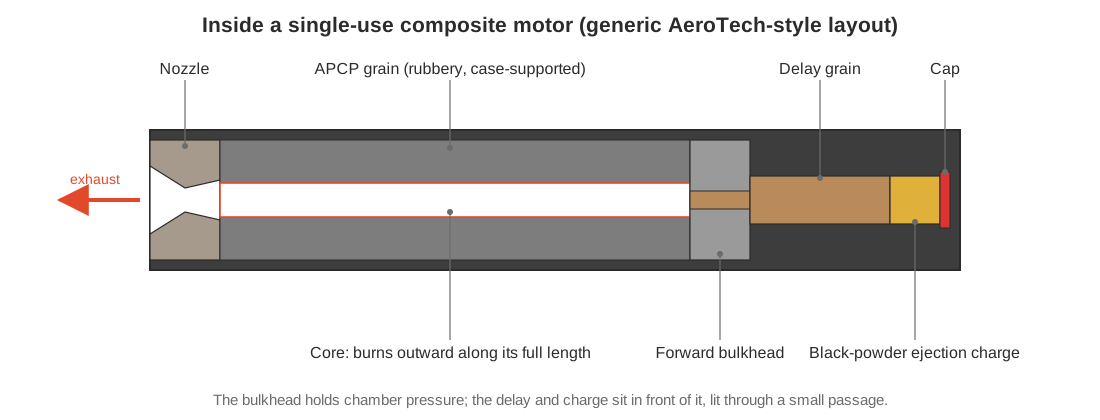
APCP burns much more slowly than pressed black powder. Tim Van Milligan’s explanation is that an end-burning composite grain simply cannot make gas fast enough to give useful thrust from a small face. To get enough burning area, nearly all composite motors are core-burners: the grain is a thick-walled tube with a hole down the middle, and it burns from the core outward along its whole length at once (Figure 3). The case and liner protect the outside of the grain, so only the core (and, in some designs, the ends) burns.
A core-burning grain makes a very different thrust curve from a black-powder end-burner. The burning area is large from the moment of ignition and changes only gradually as the core widens, so the thrust rises almost instantly to its working level and holds there, then tails off as the last slivers of propellant burn away (Figure 4). Some composite motors show a brief ignition peak, but there is no long spike-and-sustain shape. The rocket gets a hard, fairly even push for less than a second instead of a kick followed by a long, low sustain.
There are a few composite end-burners. When Tim Van Milligan wrote about them in the early 2000s, Apogee sold C4, D3, E6 and F10 end-burning composite motors for long-burning contest flights. AeroTech’s first products in 1982 included the long-burning E6 and F10 contest motors. These are deliberately low-thrust motors.
1.5.2 Why there are no composite booster motors
The same core that gives a composite motor its thrust means it cannot be used for direct staging. The hole down the middle of the grain would let hot gas reach the upper stage the moment the motor lit, long before burnout. So composite motors need a solid forward bulkhead to hold the pressure in. A delay grain cannot serve as that bulkhead, because composite delay material is rubbery like the propellant and would blow through long before the motor finished burning. Composite upper stages are therefore lit by on-board electronics: a timer or an altimeter that senses the booster’s burnout and fires an igniter in the upper-stage motor (Peak of Flight #49). Staging electronics belong to the Payload Electronics dive.
1.5.3 Two D motors compared
Figure 4 puts an Estes D12 black-powder motor and an AeroTech D21T composite motor on the same axes. They are both D motors, but:
Table 1 — Figure 4 puts an Estes D12 black-powder motor and an AeroTech D21T composite motor on the same axes. They are both D motors, but
| Estes D12 (black powder) | AeroTech D21T (composite) | |
|---|---|---|
| Diameter × length | 24 × 70 mm | 18 × 70 mm |
| Total impulse | 16.8 N·s | 19.6 N·s |
| Average thrust | 10.2 N | 20.8 N |
| Peak thrust | 29.7 N | 32.1 N |
| Burn time | 1.65 s | 0.94 s |
| Propellant | 21.1 g | 9.6 g |
| Loaded weight | 44 g | 25 g |
| Specific impulse (computed) | about 81 s | about 208 s |
All figures from the motors’ thrustcurve.org data pages. Specific impulse is total impulse divided by propellant weight, computed here; it is not a published figure.
The composite motor delivers more impulse from less than half the propellant, in a smaller diameter, at a little over half the weight. It also delivers it twice as fast. For a light, slim rocket, that is a big gain in altitude. For a heavy rocket, the D21T’s high, flat thrust is a much better push off the rod than the D12’s brief spike and low sustain.
1.5.4 Who makes them
Single-use composite motors in the model-rocket classes come mainly from AeroTech, which also owns Quest:
- AeroTech was founded by Gary Rosenfield in 1982 to make composite hobby motors. Its first products were a G30 “moonburning” motor and the E6 and F10 contest motors. It introduced the Econojet single-use line in 1997. In 2006 it announced the LMS loadable model-rocket motors, and in 2013 the DMS (Disposable Motor System) single-use motors with adjustable delays and ejection, sold with a delay-drilling tool. The company has belonged since 2004 to RCS Rocket Motor Components of Cedar City, Utah, and since 2019 its mid-power line has been sold under the Enerjet by AeroTech name.
- Quest has been owned by AeroTech’s parent since 2013. Its Q-Jet composite line began in 2018 with 18 mm A–D motors and grew to 24 × 70 mm D and E motors in 2021 and 24 × 95 mm E and F motors in 2022.
Black-powder motors come from Estes (13, 18, 24 and 29 mm) and, historically, several others. Estes’s 29 mm E16 and F15 are black-powder motors: thrustcurve.org lists both as 114 mm long, with 40 g and 60 g of propellant and a specific impulse in the mid-80s of seconds, which is black-powder territory.
A brief aside on the name Enerjet: the original Enerjet motors of 1970–1974 were the first composite model-rocket motors. AeroTech’s “Classic” propellant was formulated to mimic their look and sound (Peak of Flight #624). The history of those motors belongs to the History dive.
1.5.5 Single-use, loadable and reloadable
Composite motors come in three forms, and the differences affect cost, legality and convenience (Peak of Flight #209):
Table 2 — Composite motors come in three forms, and the differences affect cost, legality and convenience (Peak of Flight #209)
| Type | Flights per case | Assembly | Case to buy | Who may buy |
|---|---|---|---|---|
| Single-use | 1 | None: arrives ready to fly | No | Depends on size: see Buying |
| Loadable (e.g. AeroTech LMS) | 1 | Yes: parts glued into a plastic case | No | Adults only |
| Reloadable (e.g. AeroTech RMS, Cesaroni Pro-series) | Unlimited | Yes: parts assembled into a reusable metal case | Yes | Adults only |
A loadable motor is a single-use motor that the flyer assembles. Its case is plastic and is thrown away. Tim Van Milligan explained its advantage in 2008: because a loadable kit is a set of parts, with each propellant slug under 30 grams, it could be shipped through the U.S. mail without the hazardous-materials fee that an assembled G motor attracts. He also explained why a single-use case cannot simply be reloaded: the inside of a plastic case is charred and partly burned away during the firing, and a reload would burst it. Reloadable motors are the subject of the second volume.
1.5.6 Propellant colors and effects
Composite motors come in a range of propellants that differ in flame color, smoke, sound and burn rate. AeroTech marks the propellant with a letter suffix after the thrust number: the “T” in D21T, the “W” in G64W. Tim Van Milligan’s guide to choosing between them (Peak of Flight #624) lists, among others:
- White Lightning (W): brilliant white flame, dense white smoke, a throaty roar. Easy to track.
- Blue Thunder (T): violet-blue flame with little smoke, and higher thrust than White Lightning or Black Jack at the same total impulse.
- Black Jack (J) and Black Max (FJ): dense black smoke for tracking against a bright sky. Black Jack gives lower acceleration and a longer burn.
- Redline (R): scarlet flame, burn rate between White Lightning and Blue Thunder.
- Mojave Green (G): green flame, and the highest total impulse per motor size of AeroTech’s propellants.
- Warp-9 (N): AeroTech’s fastest-burning propellant, originally developed for fin motors on Orbital’s Pegasus.
- Metalstorm (M) and Dark Matter (DM): “sparky” propellants, which throw a shower of burning metal particles. Sparky motors need the area around the pad cleared of anything that will burn.
Cesaroni has its own range (Blue Streak, Classic, C-Star and others). Tim Van Milligan’s advice is to choose a propellant for its look only after a simulation has shown that the motor suits the rocket: once a motor has passed that test, the propellant changes the show more than the flight.
1.6 Certified motors
Hobby motors in the United States are certified: tested by one of the hobby’s testing organizations and found to meet the motor standard. The NAR safety codes require certified, commercially made motors, and the fire-code standards for model and high-power rocketry (NFPA 1122 and 1127) are built around the same idea.
1.6.1 What certification means
The standard is NFPA 1125, Code for the Manufacture of Model Rocket and High Power Rocket Motors. A motor cannot move from “uncertified” to “certified” until it has passed static testing to that code. The testers fire samples on a thrust stand, measure the thrust curve, total impulse, average thrust and delay, and check them against the motor’s labelled class and the code’s tolerances. The code also includes temperature tests and a limit on how hot the case may get. thrustcurve.org notes that most current manufacturers hold tighter tolerances in production than the code requires.
Three bodies do most of the testing for the North American hobby:
- The NAR Standards and Testing Committee (S&T) has traditionally certified model-rocket motors and in more recent years has also certified high-power motors.
- Tripoli Motor Testing (TMT) is the main certifier of high-power motors made in the United States. It also certifies model-rocket motors.
- The Canadian Association of Rocketry (CAR) certifies Canadian motors, notably those made by Cesaroni Technology.
The organizations, and Australia’s AMRS, accept each other’s certifications. Each publishes a list of currently certified motors, and a motor that drops off the list (because the maker stops production, or because it fails a retest) is no longer certified. Curtis Lee wrote in 2023 that motors are supposed to be retested and recertified every five years (Peak of Flight #595).
1.6.2 The certification curve is the motor’s data sheet
The thrust curve measured during certification is the most useful single piece of information about a motor. It is published, in the standard RASP (.eng) and RockSim (.rse) file formats, so that simulators can fly the motor exactly. The largest collection is thrustcurve.org, run by John Coker. He began converting raw certification test-stand data from Tripoli’s TMT into simulator files in 1998 and built the first database version of the site in 2006 (John Coker, Peak of Flight #534). It now gathers certification data and user-submitted curves for nearly every certified motor. Its motor pages show the curve and the key numbers, link to the certification documents, and note whether the motor is still in production or “OOP” (out of production).
1.6.3 The code is a label, not a measurement
The certification data also show why a motor code is only a rough guide. Curtis Lee compared the Estes A8-3 with its NAR test data. The code implies an average thrust of 8 N, but NAR S&T measured 2.32 N·s of total impulse, 3.18 N average thrust and a 2.25-second delay. By the strict reading of the code it would be an A3-2 (Peak of Flight #595). The Estes C6 in Figure 1 averages 4.7 N, not 6 N. The letter is reliable: the total impulse always falls inside its class. The thrust number and the delay are approximate. For any real decision, use the curve.
1.7 Choosing the motor for a rocket
Choosing a motor means balancing four things: getting off the launch guide fast enough to fly straight, ejecting near apogee, staying inside the field, and staying inside the rocket’s strength. Every kit’s instructions list the motors its maker has flown it on, and for a kit flown as built that list is the place to start. For anything else, the method below applies.
1.7.1 Thrust-to-weight: the 5:1 rule of thumb
The oldest rule in the hobby is that a motor’s thrust should be at least five times the rocket’s weight. One part of that thrust holds the rocket up against gravity and the other four accelerate it, so the rocket leaves the pad at about 4 g. Tim Van Milligan calls it “a blunt instrument” designed to be worked out in your head at the range table, with a wide margin for wind, imperfect motors and drag (Peak of Flight #671).
Its weakness is the word average. The number in a motor code is the average thrust over the whole burn, and black-powder motors in particular have a high spike and a low sustain. A motor that fails the 5:1 test on its average thrust can still leave the rod fast on its spike, and a motor that passes can still be marginal if its thrust builds slowly. The rule is conservative, so a range safety officer (RSO) is entitled to apply it. Tim Van Milligan’s first point on the subject is that the RSO’s decision is final.
1.7.2 Rail exit speed: the real criterion
What actually matters is how fast the rocket is moving when it leaves the rod or rail. Until then the launch guide holds it straight; after that, only air flowing over the fins does. Ion Voss gives about 13.8 m/s (around 30 mph) as the usual minimum, the speed at which the air pushes hard enough on the fins to keep the rocket pointed where it should go (Peak of Flight #498). Tim Van Milligan gives the high-power consensus as 30–50 ft/s (about 9–15 m/s): under 30 ft/s, the fins may not have enough authority to fight the wind. Over 50 ft/s, the rocket is aerodynamically safe (Peak of Flight #671).
Rail exit speed depends on the thrust curve, the rocket’s weight and the length of the guide, so it has to be calculated, not read from a code. RockSim and OpenRocket report it for every simulated flight. A longer rod or rail is the usual fix for a marginal case, and the next more powerful motor is the other.
1.7.3 The delay: ejection at apogee
The right delay puts ejection at apogee, when the rocket is moving most slowly. A parachute deployed there opens gently. A delay that is too short opens it while the rocket is still climbing fast, which can strip or shred it. A delay that is too long opens it after the rocket has turned over and started falling, sometimes nose first, which loads the recovery harness hard and may not slow the rocket in time (Figure 6).
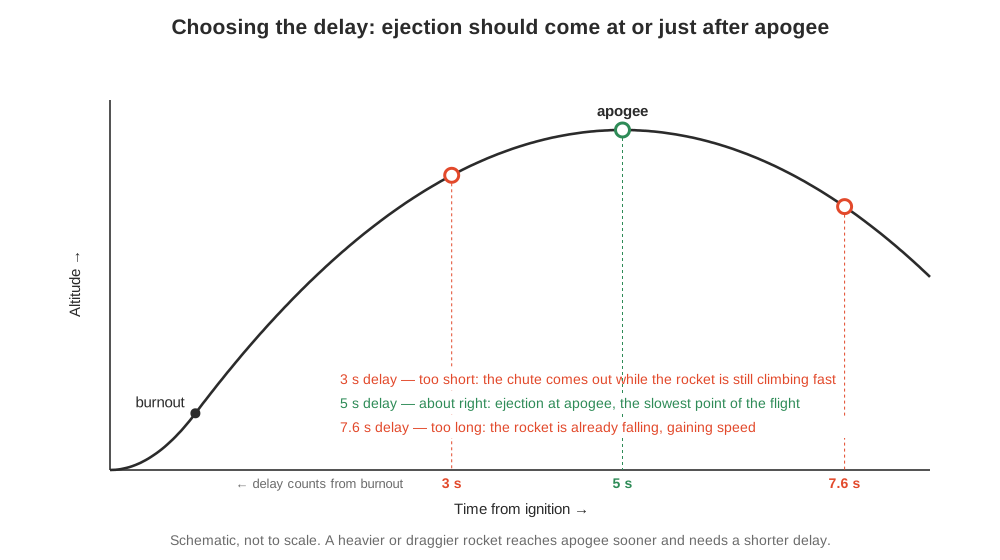
The best delay depends on the rocket, not just the motor. A heavier or draggier rocket coasts for a shorter time and needs a shorter delay. That is why motor charts give each delay its own maximum liftoff weight. Tim Van Milligan’s example uses the Apogee Avion on an Estes C6. With a C6-5, the rocket ejects right at apogee if it weighs 100 g. With a C6-3, it can weigh about 175 g and still eject at apogee. Both motors push equally hard. The shorter delay simply suits a heavier rocket, and a C6-5 in a 175 g rocket would eject on the way down (Peak of Flight #201).
Because the delay tolerance is wide (see Delay and ejection), the usual practice is to simulate the flight, read the optimum delay from the simulation, and choose the nearest available delay, leaning shorter for a fragile rocket or recovery system. Wind makes the rocket weathercock and reach apogee earlier and lower, which also favours the shorter delay.
1.7.4 A step-by-step method
Tim Van Milligan’s procedure, which Apogee uses to build its own motor charts, is to start from a simulation of the rocket (Peak of Flight #624):
- Build or download the rocket’s design file in RockSim or OpenRocket, with its real weight, including the motor.
- Let the simulator try every motor that fits. RockSim’s Recommend Motors runs a simulation for every motor in its database that fits the mount, using the launch-guide length actually in use, and flags those that fly safely. The safety tests include rail exit speed and whether apogee falls inside a 40° cone above the pad, a measure of how far the rocket weathercocks.
- Sort the safe motors by altitude and choose one that will stay inside the field. A rocket that goes higher drifts further on its parachute and is harder to recover.
- Narrow by type: black powder or composite, single-use or reloadable.
- Pick the delay closest to the simulated optimum.
- Choose the propellant for the show last of all.
For the first flight of a new rocket, the kit maker’s advice still applies: fly the smallest recommended motor, low and close, to test the build.
1.8 Buying motors
1.8.1 What anyone can buy
In the United States, motors from 1/4A up to F can be bought over the counter by anyone, subject to state and local law. They fall under a federal Consumer Product Safety Commission exemption that covers model-rocket propellant devices sold for light, recoverable, reflyable rockets. The exemption, at 16 CFR 1500.85(a)(8), applies only to motors that:
- are lit electrically;
- contain no more than 62.5 grams of propellant and produce less than 80 N·s of total impulse, with thrust lasting at least 0.05 seconds;
- come with all their chemicals preloaded in a paper or similar non-metallic tube that will not fragment into sharp pieces; and
- are built so that they will not burst in normal use, will not ignite spontaneously, and carry no charge beyond the recovery-system charge.
1.8.2 Mid-power: E, F and G
The hobby uses mid-power loosely for motors from E to G, from 20 to 160 N·s. These motors are still inside the model-rocket rules: the NAR’s model-rocket code allows up to 320 N·s of installed impulse, the equivalent of two G motors. But motors outside the CPSC exemption above are sold to adults only. That takes in every G motor (more than 80 N·s), every loadable kit (assembled by the flyer) and every reload kit (assembled into a metal case). The instruction sheets for reload kits say plainly that federal law prohibits their sale to anyone under 18, and dealers verify the buyer’s age before they ship (Peak of Flight #209).
Two more limits matter at the top of the G class. A motor with more than 62.5 g of propellant is outside the small-motor exemptions in the federal explosives and transport rules. And the NFPA definition puts any rocket flying a motor of 80 N average thrust or more in the high-power class. Motors beyond either limit are sold and flown as high-power motors, whatever their letter (volume 2). The AeroTech G80T sits right at the edge: 62.5 g of propellant, 136.6 N·s and 77.6 N average thrust.
1.8.3 Sizes
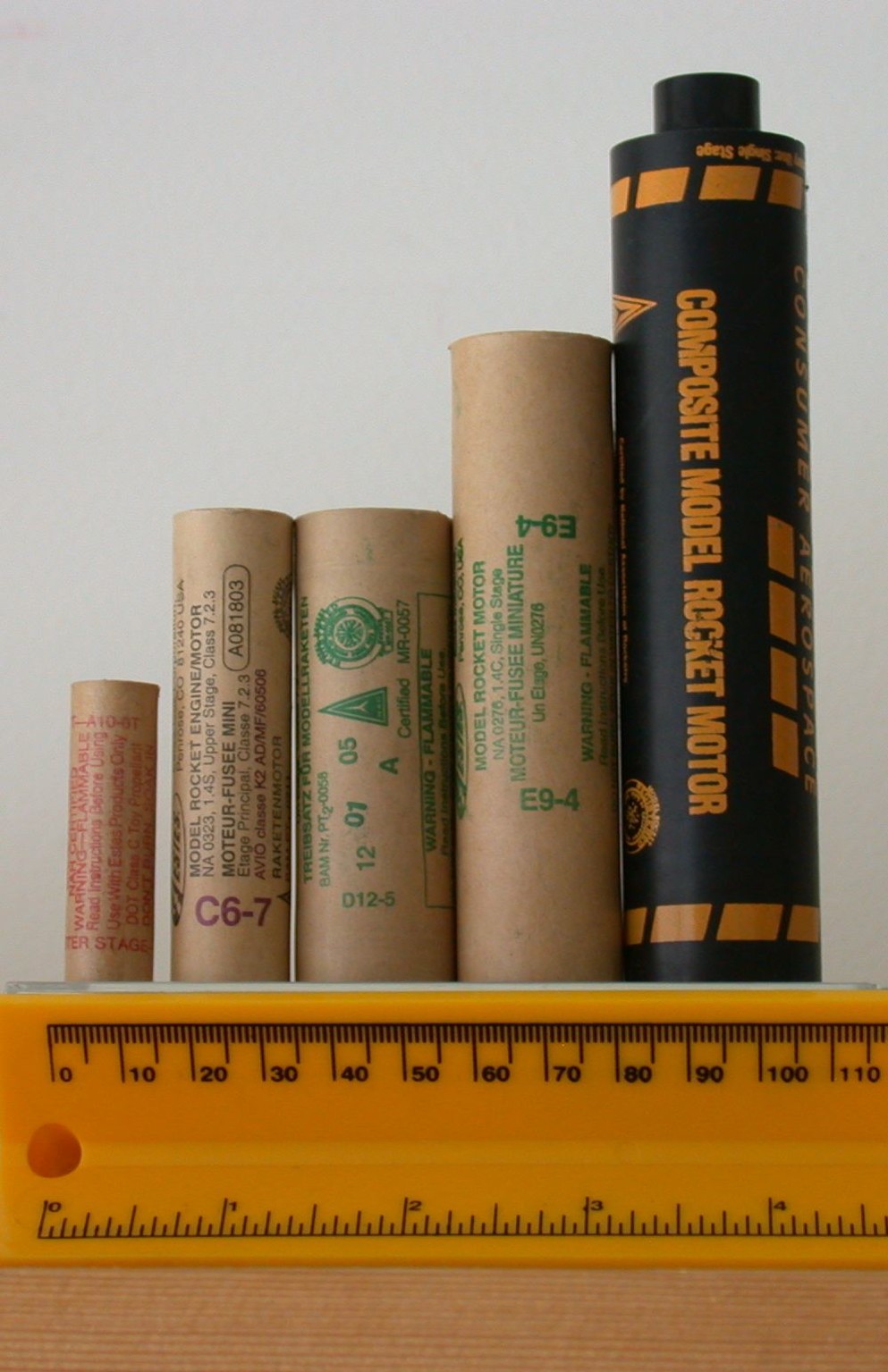
The common motor sizes are:
Table 3 — The common motor sizes are
| Diameter | Typical motors |
|---|---|
| 13 mm | Estes mini motors (1/4A–A) |
| 18 mm | Estes A–C; composite D (AeroTech D21T; Quest Q-Jet A–D) |
| 24 mm | Estes C11, D12, E12, E9; composite D–F (AeroTech E30T, F32T; Q-Jet D–F) |
| 29 mm | Estes E16 and F15; composite E–G, including AeroTech 29 mm single-use G motors and the RMS-29 reloads |
Sizes and motors from the makers’ histories and the motors’ thrustcurve.org pages.
A motor of one size can fly in a larger mount with an adapter: a short tube with centering rings and its own motor hook or retainer. Without that, the motor will be blown out of the back at ejection.
1.8.4 Where to buy
Estes black-powder motors are sold in hobby shops, craft chains and toy stores. Composite single-use motors and the larger black-powder motors are sold by hobby dealers, by online rocketry vendors and at the motor vendor’s table at large club launches. Buying at a launch avoids shipping entirely. Online dealers ship motors as hazardous materials, which used to mean a hazmat fee per box on any shipment that could not go by mail. The rules and fees for shipping change, and the dealer’s own shipping page is the current authority.
1.9 Igniters, in brief
Model-rocket motors are lit electrically, and the NAR safety code requires it, so that everyone can stand back. An igniter (the hobby also says starter or initiator) is two lead wires joined at the tip by a thin nichrome bridgewire. The launch controller passes current through it, the bridgewire glows red-hot, and in most igniters it lights a pyrogen coating, a match-head composition that flares and lights the propellant.
Black powder lights easily. The current Estes Starter is a bare nichrome bridgewire dipped in a whitish glue, with no pyrogen, and Bobby Potter and Tim Van Milligan note that it works only on black-powder motors and needs at least a 6-volt controller. Composite propellant needs far more heat to light, so composite motors come with pyrogen-tipped igniters such as AeroTech’s FirstFire and Copperhead. The very fine bridgewires of chip-board igniters and e-matches heat quickly but carry too little heat to light composite propellant reliably (Peak of Flight #527). The rule of thumb is to use the igniter supplied with the motor.
Igniters, launch controllers and pads are the subject of the Launchers dive.
1.10 Storage, transport and disposal
1.10.1 Storage
The same conditions that cause CATOs cause most motor problems, so storage advice is short:
- Cool and dry. Estes’s safety data put the storage range at 0–60 °C (32–140 °F), dry and well ventilated, away from water and humidity.
- No temperature cycling. Do not keep motors in a car, garage or shed that bakes in summer and freezes in winter.
- Away from igniters and heat sources, and out of children’s reach. Igniters are never stored installed in a motor.
- Inspect before use. Reject any motor with a bulging or unwrapping case, a crumbling nozzle or cap, or propellant showing at the cap.
Composite motors and reload kits carry their own storage instructions. Cesaroni’s, for example, give a use-within date and a storage temperature range on every sheet (volume 2).
1.10.2 Transport
In the United States, the federal explosives regulations exempt model-rocket motors with 62.5 g of propellant or less (27 CFR 555.141). Carrying them by car to a launch is therefore governed mainly by state and local fire codes. Packed in their original packaging, in a closed box, away from igniters and from anything hot, they are as safe as they can be made.
1.10.3 Disposal and misfires
Misfires. If a motor does not light when the button is pressed, the safe sequence is: remove the safety key from the controller, and wait at least 60 seconds before approaching the rocket. A motor can hang fire, smolder and then light. After the wait, the igniter can be replaced at the pad, or the rocket removed.
Disposal of black-powder motors. Estes’s guidance for damaged, suspect or unwanted motors is to soak them in water until they disintegrate, which makes them harmless, and then put the remains in an outdoor waste bin.
Disposal of composite motors. APCP does not dissolve in water the way black powder breaks down. Cesaroni’s instructions, for example, call for the grains to be burned in a shallow hole away from anything combustible, lit electrically from at least 10 m. A misfired composite motor is best handed to the launch’s range safety officer, or dealt with according to the maker’s sheet.
1.11 Safety, briefly
The NAR Model Rocket Safety Code is the rulebook for everything in this volume, and Basic Rockets volume 1 summarizes it. For motors in particular:
- Use certified, commercially made motors only, and never alter them: no drilling, no cutting, no “improving” the delay, no reusing a spent case.
- Use the motor in the rocket it is meant for, and stay inside the rocket’s maximum liftoff weight for that motor and delay.
- Retain the motor positively: a hook, clip or screw-on retainer, not friction alone.
- Install the igniter only at the pad (or in the range’s designated prep area), with the rocket pointed in a safe direction.
- Stand back the full distance in the code for the motor’s class, and do not approach a misfire until the key is out and a minute has passed.
- Clear the pad area for sparky motors.
1.12 Where this volume hands off
- High-power and reloadable motors, APCP grain design, certification levels H–O and research motors: volume 2 of this dive.
- Igniters, controllers, pads, rods and rails: the Launchers dive.
- Ejection charges, baffles, chute sizing and electronic deployment: the Recovery and Payload Electronics dives.
- Simulating a rocket and choosing its motor in software: the RockSim dive.
- The history of the motors: Carlisle, Estes, Enerjet and the coming of composites: the History dive.
Sources
I have read nearly every issue of Apogee Components’ Peak of Flight newsletter, and the issues below, held in the site’s Library, carry most of the practical advice in this volume.
- Tim Van Milligan, “Composite Propellant Booster Motors?”, Peak of Flight #49 (undated, 2000–2005). (Library copy)
- Tim Van Milligan, “Delay Time and Maximum Lift-Off Weight”, Peak of Flight #201 (2008). (Library copy)
- Ken Kosanke, “Terminology of Model Rocketry — Part 3” (propellant grain geometry), Peak of Flight #341 (2013). (Library copy)
- Tim Van Milligan, “What is a Loadable Rocket Motor?”, Peak of Flight #209 (2008). (Library copy)
- Ion Voss, minimum velocity off the launch rod, Peak of Flight #498 (2019). (Library copy)
- Bobby Potter and Tim Van Milligan, “Which Starter to Use for Your Rocket Motors?”, Peak of Flight #527 (2020). (Library copy)
- John Coker, “A History of Motor Analysis & Thrustcurve.org”, Peak of Flight #534 (2020). (Library copy)
- Curtis Lee, “Why You Should Never Judge an Engine by its Engine Code”, Peak of Flight #595 (2023). (Library copy)
- Tim Van Milligan, “Picking Propellant Types from Aerotech and Cesaroni”, Peak of Flight #624 (2024). (Library copy)
- Tim Van Milligan, “The 5:1 Ratio vs. Reality”, Peak of Flight #671 (2026). (Library copy)
- thrustcurve.org (John Coker), motor data pages and simulator files for the Estes A8, B6, C6, D12, E12, E16 and F15, the AeroTech D21T, E30T, F32T and G80T and the Quest Q-Jet motors; “Motor Certification” — https://www.thrustcurve.org/info/certification.html. Specific impulses in this volume are computed from those pages’ total impulse and propellant weight.
- AeroTech/Quest, company history — https://aerotech-rocketry.com/pages/history.
- Estes Industries, “Can I use my older engines? How should they be stored?” — https://help.estesrockets.com/article/49-can-i-use-my-older-eng; and engine safety data sheet (storage range).
- U.S. Code of Federal Regulations, 16 CFR 1500.85(a)(8), model-rocket propellant devices — https://www.law.cornell.edu/cfr/text/16/1500.85.
- Bureau of Alcohol, Tobacco, Firearms and Explosives, “Commerce in Explosives — Hobby Rocket Motors”, final rule, Federal Register vol. 71, no. 155 (11 August 2006) — https://www.govinfo.gov/content/pkg/FR-2006-08-11/html/06-6862.htm (the 62.5 g exemption and its history).
- Wikipedia, Gunpowder (composition), Ammonium perchlorate composite propellant (composition, specific impulse) and High-power rocketry (the NFPA high-power definition), for orientation.
- National Association of Rocketry, Model Rocket Safety Code — https://nar.org/ModelRocketSafetyCode (summarized, not quoted).